
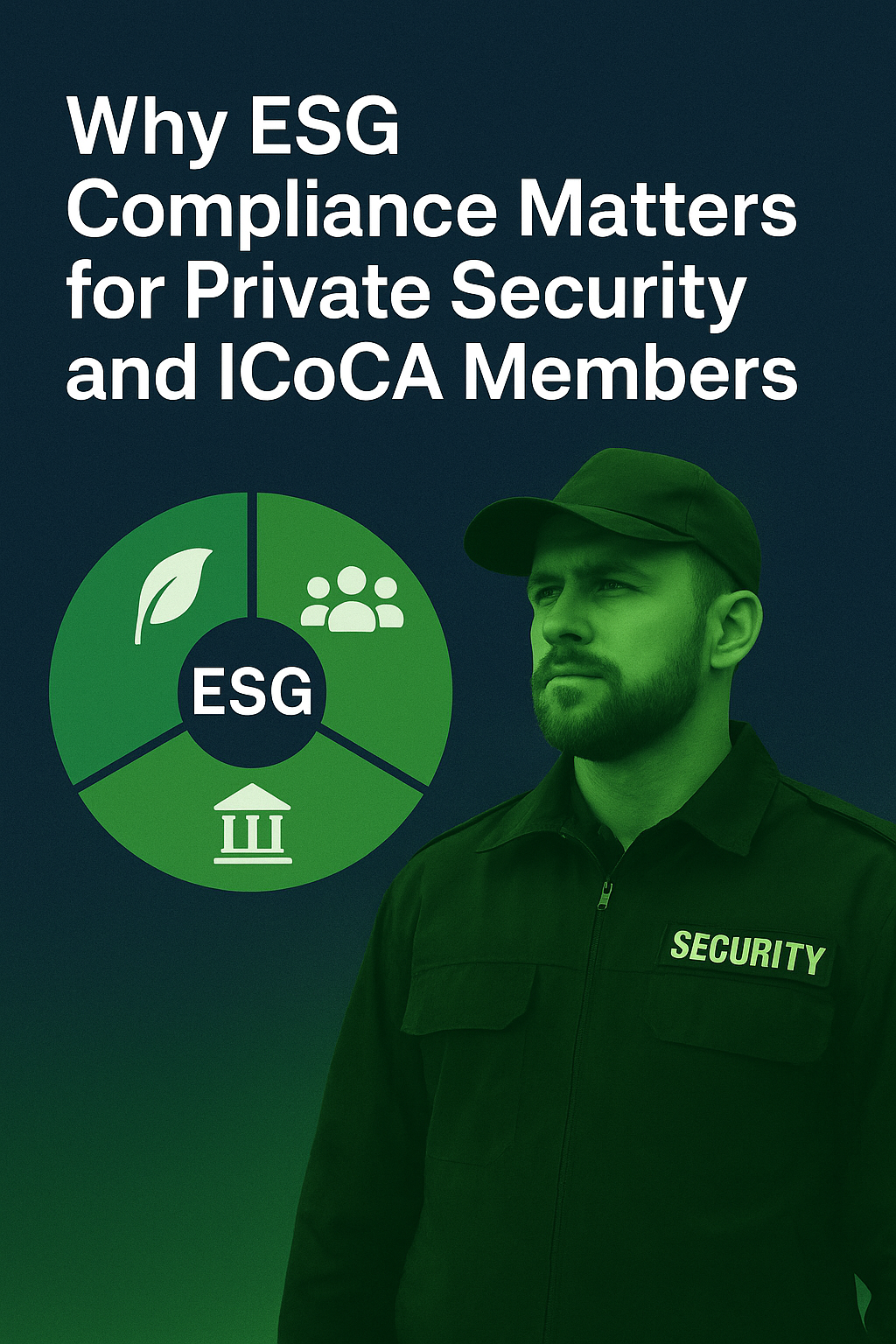
Why ESG Compliance Matters for Private Security and ICoCA Members?
 In recent years, the private security industry has undergone a major transformation. Clients, regulators, and international organizations are no longer looking only at operational capability — they now expect companies to demonstrate ethical conduct, Human Rights, social responsibility, and environmental awareness. This is where Environmental, Social, and Governance (ESG) compliance becomes essential, especially for companies that are members of the International Code of Conduct Association (ICoCA).
1. ESG and ICoCA: Shared Principles of Responsible Conduct
The ICoCA Code of Conduct promotes respect for human rights, ethical business behavior, and accountability — values that align perfectly with ESG principles.
- Environmental (E): Provide a healthy environment for employees, reducing pollution, managing waste responsibly, and minimizing carbon footprints in operations.
- Social (S): Ensuring fair labor practices, protecting human rights, and engaging positively with local communities.
- Governance (G): Upholding transparency, anti-corruption, and strong internal compliance systems.
For ICoCA members, adopting ESG practices reinforces their commitment to responsible operations and continuous improvement — turning principles into measurable action.
2. Meeting Client and Contractual Expectations
While ESG compliance may not yet be legally mandatory, it is rapidly becoming a contractual requirement for international clients.
Major organizations — including the UN, IFC, oil and gas operators, and NGOs — increasingly assess suppliers and contractors based on ESG performance.
For private security companies, having an ESG framework in place can mean the difference between winning or losing contracts. It demonstrates that the company operates ethically, manages its risks, and contributes to sustainable development goals.
3.Building Trust and Reputation
The private security sector operates in complex and often high-risk environments. Transparency and accountability are key to maintaining client confidence and public trust.
An independent ESG rating or compliance report provides tangible evidence of a company’s ethical and sustainable performance.
For ICoCA members, this further enhances credibility, showing that they not only follow the Code but go beyond it by measuring and reporting their impact.
4.Preparing for Future Regulations
Globally, governments and investors are moving toward mandatory sustainability reporting. By integrating ESG into their management systems today, ICoCA members can stay ahead of regulatory changes and ensure long-term operational resilience.
ESG compliance is not just about reputation — it’s about future-proofing the business and maintaining competitiveness in a rapidly changing global market.
5.From Compliance to Leadership
Ultimately, ESG compliance empowers private security companies to become leaders in responsible operations.
By aligning with ICoCA principles and adopting ESG frameworks, these companies demonstrate that security and sustainability can go hand in hand — protecting people, assets, and the planet.
In conclusion:
ESG compliance is no longer optional for private security companies — it is a strategic necessity. For ICoCA members, it reinforces the very principles they are built on: accountability, respect, and continuous improvement.
Those who embrace ESG today will not only meet tomorrow’s requirements but also build stronger, more trusted, and more sustainable organizations.
Discover more from Green Perennial-HSEQ-ESG
Subscribe to get the latest posts sent to your email.