How Iraqi Companies Can Successfully Join Approved Vendor Lists such as Avetta, and Why Many Applications Get Rejected

Introduction

Many multinational corporations, oil and gas operators, construction companies, and industrial organizations now require their suppliers and contractors to be registered on approved vendor management platforms such as Avetta before awarding contracts.

For Iraqi companies, becoming an approved supplier on Avetta can open doors to significant business opportunities with international clients. However, many companies struggle to achieve approval or experience lengthy delays due to common compliance and documentation gaps.

This article explains how Iraqi businesses can successfully qualify for approved vendor lists and avoid the mistakes that often lead to rejection.

Common Reasons Companies Are Rejected

1. Missing HSE Documentation

One of the most common reasons for rejection is the absence of a structured Health, Safety, and Environmental (HSE) management system.

Many companies submit only a basic HSE policy but lack supporting procedures such as:

  • Risk Assessment Procedure
  • Incident Reporting Procedure
  • Emergency Response Plan
  • Training and Competency Procedure
  • Contractor Management Procedure
  • Environmental Management Procedure

Without these documents, clients may consider the company unprepared to manage operational risks.

2. Inadequate Safety Performance Records

Companies are often unable to provide:

  • Total Recordabl Incident Rate (TRIR)
  • Lost Time Injury Frequency Rate (LTIFR)
  • Incident statistics
  • Near-miss records
  • Corrective action records

Even companies with excellent safety performance can face challenges if they do not maintain proper records.

3. Lack of International Certifications

Although certifications are not always mandatory, many clients favor suppliers holding:

  • ISO 9001 Quality Management System
  • ISO 14001 Environmental Management System
  • ISO 45001 Occupational Health and Safety Management System
  • ISO 27001 Information Security Management System

Companies without these certifications may appear less mature from a management perspective.

4. Insufficient Insurance Coverage

Many Iraqi companies underestimate the importance of insurance.

Clients may require:

  • General Liability Insurance
  • Employer’s Liability Insurance
  • Professional Indemnity Insurance
  • Automobile Insurance

Failure to provide valid insurance documentation can delay or prevent approval.

5. Incomplete Employee Competency Records

Companies often fail to maintain:

  • Training matrices
  • Qualification certificates
  • Professional licenses
  • Competency assessments
  • Employee CVs

Clients want assurance that personnel performing work are competent and qualified.

6. Poorly Prepared Company Information

Simple issues such as outdated company profiles, expired licenses, missing organizational charts, or inconsistent business information can create negative impressions during the review process.

7. Failure to Respond to Corrective Actions

Avetta reviewers frequently request clarification or additional evidence.

Many companies delay responding or provide incomplete information, causing prolonged review periods and potential rejection.

How Iraqi Companies Can Successfully Achieve Approval

Establish a Formal Management System

Develop documented systems covering:

  • Health and Safety
  • Quality Management
  • Environmental Management
  • Training and Competency Management
  • Risk Management

These systems should be implemented and supported by records.

Prepare a Complete Documentation Package

Before starting registration, ensure availability of:

  • Company Registration Documents
  • Company Profile
  • HSE Manual
  • Quality Manual
  • Organizational Chart
  • Training Matrix
  • Insurance Certificates
  • Employee Competency Records
  • Incident Statistics

Consider ISO Certification

Implementing internationally recognized standards significantly improves credibility and demonstrates commitment to continual improvement.

Maintain Accurate Safety Records

Track and report:

  • Incidents
  • Near misses
  • Corrective actions
  • Training activities
  • Safety meetings

Reliable records help demonstrate a proactive safety culture.

Assign a Dedicated Compliance Coordinator

Many successful companies appoint a focal point responsible for:

  • Managing registrations
  • Uploading documents
  • Responding to reviewer comments
  • Maintaining compliance records

This greatly improves approval timelines.

Seek Professional Support

Companies unfamiliar with Avetta requirements often benefit from engaging consultants who understand:

  • Contractor prequalification systems
  • ISO standards
  • HSE management systems
  • Vendor compliance requirements

Professional guidance can reduce delays and improve approval success rates.

Conclusion:

Avetta registration is more than an administrative exercis. It is a demonstration of a company’s commitment to safety, quality, compliance, and operational excellence.

For Iraqi companies seeking to compete in international markets, investing in proper management systems, documentation, and compliance programs can significantly increase the likelihood of becoming an approved supplier.

Organizations that proactively address compliance requirements not only improve their chances of approval but also strengthen their overall business performance and reputation in the global marketplace.

Call to act if you need an expert for preparation

ceo@perennialhse.com

00964 7502413431


ISO 14001:2026 Explained: What Organizations Need to Know About the New Environmental Management System Standard

Environmental sustainability has become a critical business priority across every industry. Governments, investors, customers, and stakeholders increasingly expect organizations to demonstrate environmental responsibility and measurable sustainability performance. In response to these growing expectations, the latest version of the Environmental Management System (EMS) standard, ISO 14001:2026, has been released.

ISO 14001 remains the world’s most recognized environmental management standard, helping organizations identify, control, monitor, and improve their environmental performance. While ISO 14001:2026 maintains the core framework established in ISO 14001:2015, it introduces important updates to address climate change, supply chain sustainability, environmental risks, and performance measurement.

For organizations currently certified to ISO 14001:2015, understanding these changes is essential for a successful transition and continued certification.

Read More

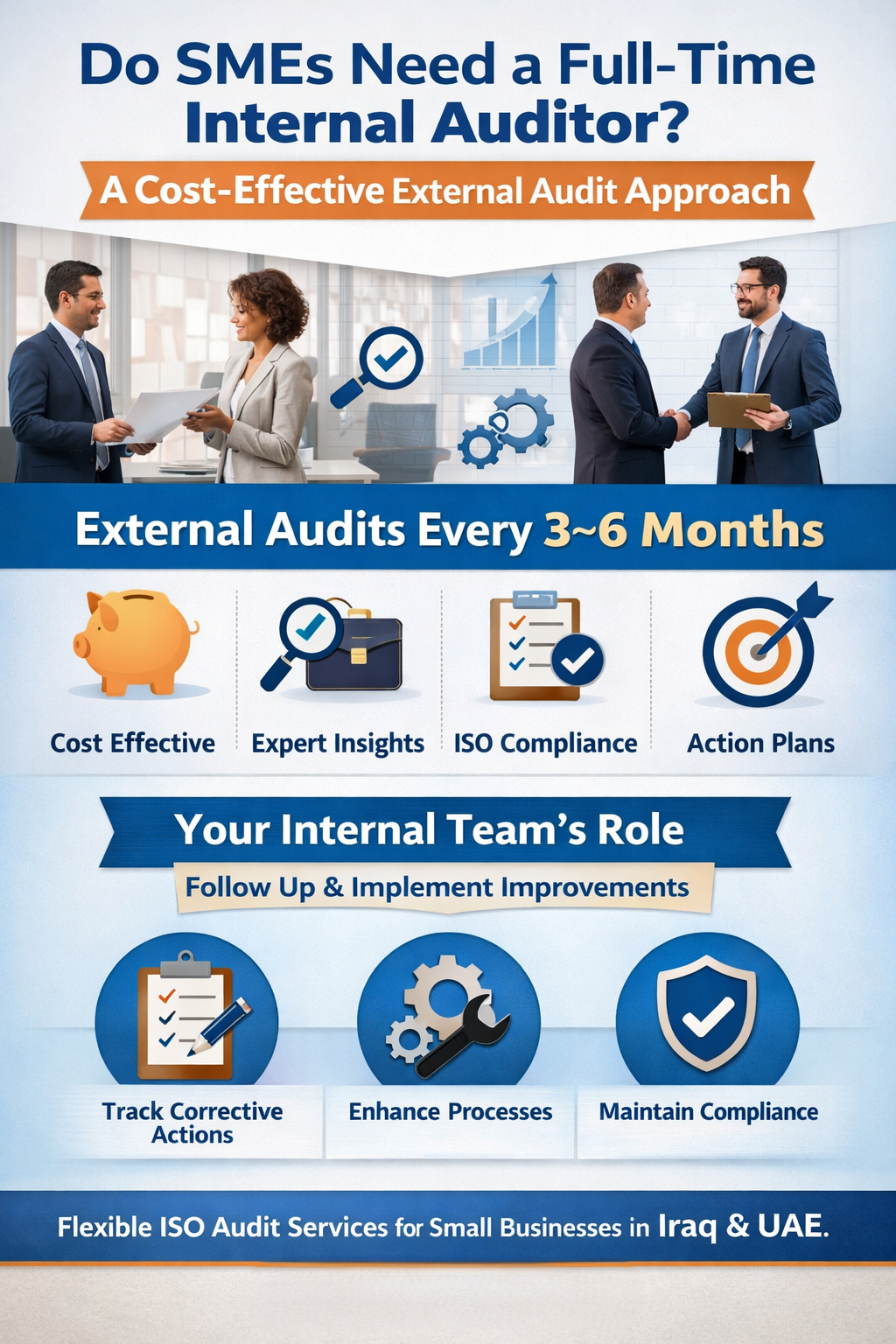
“Do SMEs Need a Full-Time Internal Auditor? A Cost-Effective External Audit Approach”

A Guide to Outsourcing the Internal Audit Function


For many small to medium-sized enterprises (SMEs), building an effective management system—whether for quality, safety, security, or environmental compliance—is a top priority. But one common question arises:

Do we really need a full-time internal auditor?

The short answer: not always. Internal audit outsourcing entails using a third-party or outside company to serve as your third line of the continual improvement system, which means engaging internal auditing services of independent professionals who are not necessarily the company’s employees.

The Reality for SMEs

Hiring a full-time internal auditor can be costly and, in many cases, unnecessary for smaller organizations. Unlike large corporations with complex structures and continuous audit requirements, SMEs typically:

  • Have simpler processes
  • Operate with lean teams
  • Require periodic—not constant—auditing

A full-time auditor may end up underutilized, adding cost without proportional value.

Read More

What Are The Role of Environmental Impact Assessment (EIA) Reports in Oil & Gas Projects

The Critical Role of Environmental Impact Assessment (EIA) Reports in Oil & Gas Projects


Oil and gas projects bring significant economic benefits—but they also pose serious risks to the environment, local communities, and long-term sustainability. That’s why Environmental Impact Assessment (EIA) reports play a vital role before any project begins. In fact, an EIA is often a legal requirement in many countries and a key expectation from international investors, regulators, and stakeholders.

Below is a clear breakdown of why EIAs are essential in the oil and gas sector and how they support responsible project development.


1. Ensuring Environmental Protection

Oil and gas activities—exploration, drilling, production, transportation—can affect air quality, water resources, soil, biodiversity, and marine life.
An EIA identifies these potential impacts before any equipment touches the ground. It allows companies to:

  • Map sensitive habitats and ecosystems.
  • Predict pollution risks
  • Identify species and natural resources at risk.
  • Develop mitigation strategies to minimize environmental damage

By doing this early, companies avoid irreversible harm and reduce future operational and legal risks.

2. Supporting Regulatory Approvals

Most governments require an EIA before issuing permits for oil and gas projects.
A well-prepared EIA helps companies:

  • Demonstrate environmental responsibility
  • Comply with national laws and international environmental standards.
  • Gain approval from ministries, environmental agencies, and energy regulators.

In regions such as Iraq, the UAE, and other oil-producing countries, the EIA is a mandatory document required before project commencement.

3. Safeguarding Community Health and Safety

Oil and gas operations can affect nearby communities through:

  • Noise pollution
  • Waste and effluent discharge
  • Air emissions
  • Groundwater and surface water contamination
  • Traffic impacts

An EIA includes baseline studies and social assessments to understand how the project might impact local people. This allows companies to reduce social risks, protect public health, and maintain a positive reputation with stakeholders.

4. Reducing Project Delays and Costs

Identifying environmental risks early helps companies plan better.
Without an EIA, unexpected issues can stop a project mid-way, causing:

  • Regulatory penalties
  • Community opposition
  • Litigation
  • Delays in project execution

An accurate EIA enables better budgeting, risk planning, and resource allocation—saving companies millions in future corrective actions.

5. Improving Sustainability and ESG Performance

In today’s world, investors and clients want to work with companies that prioritize sustainability.
An EIA strengthens ESG performance by showing:

  • Clear environmental risk management
  • Transparent reporting
  • Commitment to biodiversity and resource protection. Focus on long-term sustainability goals

This builds trust with partners, regulators, and international organizations.

6. Guiding Environmental Management Plans (EMP)

An EIA is not just a report—it is the foundation for the project’s Environmental Management Plan, which outlines:

  • Mitigation measures
  • Monitoring requirements
  • Emergency response plans
  • Waste management strategies
  • Restoration and rehabilitation plans

This ensures environmental protection throughout the project life cycle, not just at the beginning.

Conclusion

The Environmental Impact Assessment (EIA) is a crucial step in the oil and gas project life cycle.
By conducting the EIA before project commencement, companies:

✔ Protect the environment
✔ Build community trust
✔ Meet regulatory requirements
✔ Strengthen ESG credibility
✔ Avoid costly setbacks
✔ Ensure long-term sustainable development

Oil and gas companies that prioritize EIAs demonstrate leadership, responsibility, and a commitment to safe and sustainable energy production.


We predict potential environmental impacts, plan effective mitigation measures, and evaluate projects to ensure sustainable outcomes..