
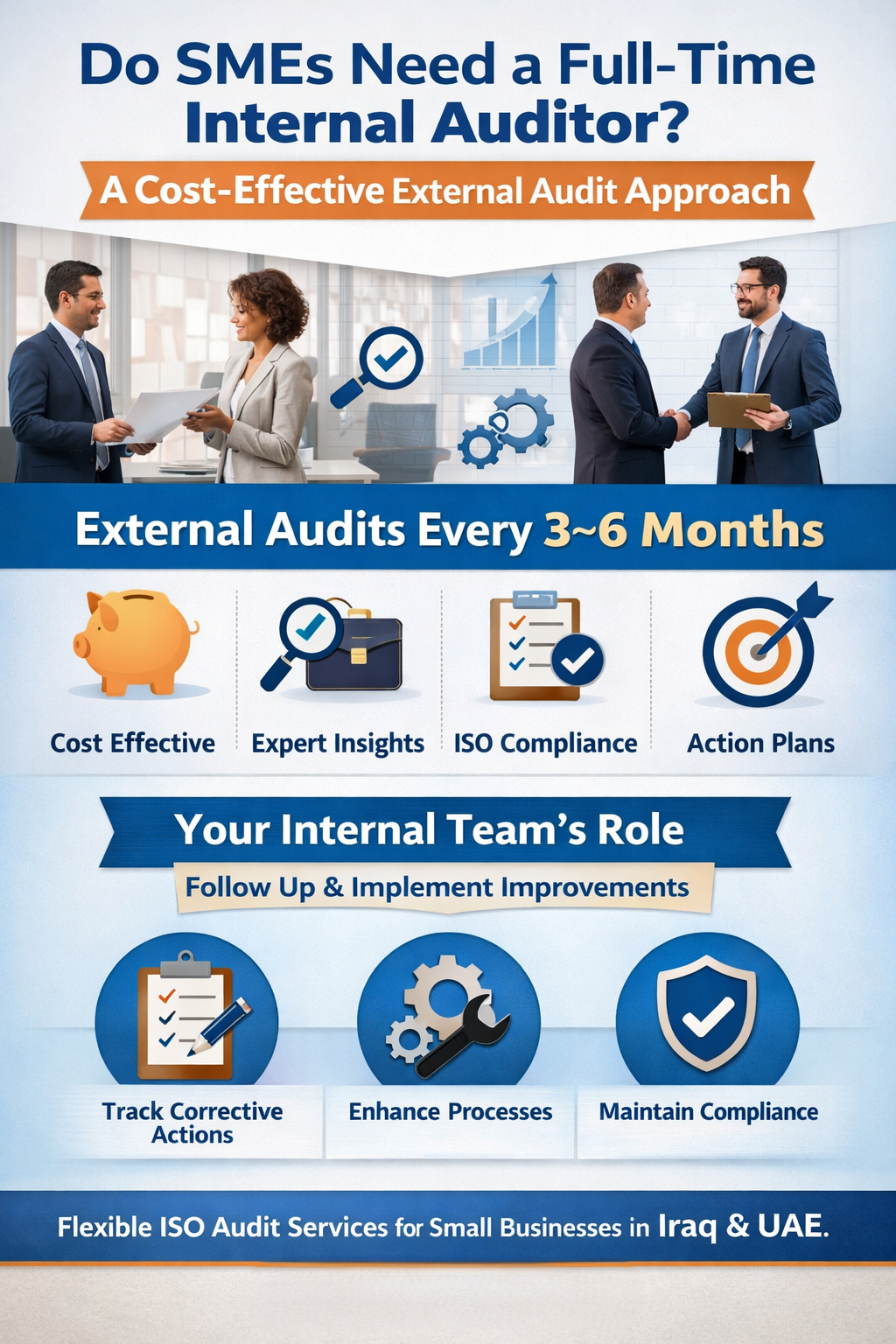
“Do SMEs Need a Full-Time Internal Auditor? A Cost-Effective External Audit Approach”
A Guide to Outsourcing the Internal Audit Function

For many small to medium-sized enterprises (SMEs), building an effective management system—whether for quality, safety, security, or environmental compliance—is a top priority. But one common question arises:
Do we really need a full-time internal auditor?
The short answer: not always. Internal audit outsourcing entails using a third-party or outside company to serve as your third line of the continual improvement system, which means engaging internal auditing services of independent professionals who are not necessarily the company’s employees.
The Reality for SMEs
Hiring a full-time internal auditor can be costly and, in many cases, unnecessary for smaller organizations. Unlike large corporations with complex structures and continuous audit requirements, SMEs typically:
- Have simpler processes
- Operate with lean teams
- Require periodic—not constant—auditing
A full-time auditor may end up underutilized, adding cost without proportional value.
A Smarter Approach: Periodic External Audits
Instead of maintaining a full-time position, many SMEs are shifting toward quarterly or semi-annual external audits conducted by experienced professionals.
This approach provides expert-level insight without long-term overhead costs.
Key Benefits of Hiring an External Auditor Periodically
1. Cost Efficiency
You only pay for the service when needed—quarterly or every six months—making it far more budget-friendly than a full-time salary.
2. Higher Expertise and Objectivity
External auditors bring diverse industry experience and a fresh, unbiased perspective. They can quickly identify gaps that internal teams may overlook.
3. Stronger Compliance and Readiness
Regular external audits ensure your company stays aligned with standards such as ISO 9001, ISO 14001, ISO 45001, ISO 18788, or PSC.1.
4. Focused Improvement Plans
Instead of routine internal checks, external auditors deliver clear corrective actions and structured improvement plans.
The Practical Model That Works
A highly effective model for SMEs is:
- Conduct external audits every 3–6 months
- Develop a corrective action plan
- Assign internal team members to:
- Follow up on actions
- Monitor progress
- Maintain documentation
This creates a balance between professional oversight and internal ownership.
The Role of Your Internal Team
Even without a full-time auditor, your internal team still plays a crucial role:
- Tracking corrective actions
- Implementing improvements
- Preparing for certification or surveillance audits
- Maintaining daily compliance
Think of your team as the engine, and the external auditor as the navigator.
When a Full-Time Auditor Might Be Necessary
There are cases where hiring a full-time internal auditor makes sense, such as:
- Rapidly growing companies
- High-risk industries (e.g., oil & gas, aviation, large-scale security operations)
- Organizations managing multiple certifications across regions
- But for most SMEs, this level of investment is not required—at least not initially.
Final Thoughts
For small to medium-sized companies, success is about efficiency and smart resource allocation.
Instead of committing to a full-time internal auditor, consider a flexible model using experienced external auditors on a quarterly or semi-annual basis. Combined with strong internal follow-up on corrective actions, this approach delivers:
- Better value for money
- Stronger compliance
- Continuous improvement of your management system
How Green Perennial Company can help SMEs for continual improvement:
We can conduct internal audits by our experts every quarter or 6 months, depending on the company’s requirements, with action plans for improvement and follow-up until final corrective actions.
“Looking for cost-effective ISO audit support in Iraq or UAE? Contact us today for quarterly or semi-annual external audit services tailored for SMEs.”
Call to Act
Discover more from Green Perennial-HSEQ-ESG
Subscribe to get the latest posts sent to your email.